
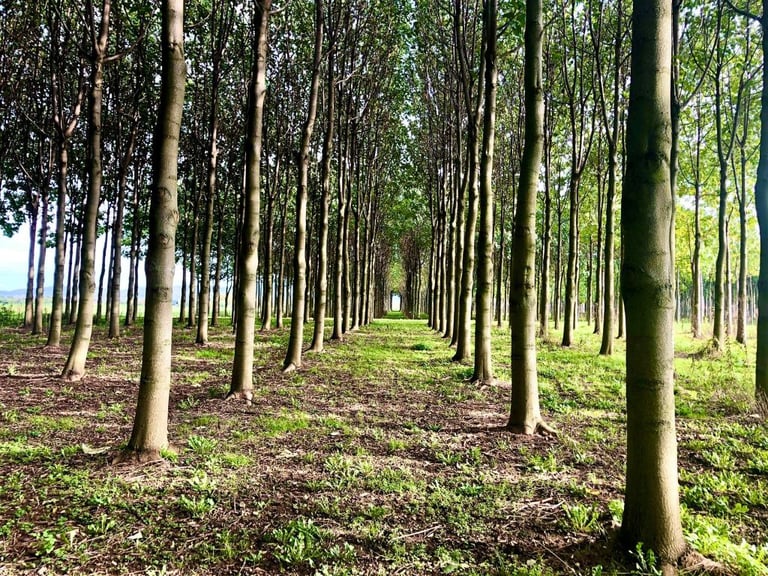
Exceptional CO₂ absorption
Paulownia absorbs up to 30 tons of CO₂ per hectare per year — more than any other commercially grown tree. This makes the crop valuable not only as a raw material, but also as an instrument in the climate transition.
Dealin.Green is committed to the transition to biobased construction. With European support, we bring the Paulownia tree from the field to the construction site — sustainable, lightweight and climate-friendly.
The construction sector faces an enormous task worldwide: less CO₂ emissions, fewer fossil raw materials and more circularity. Biobased construction — building with materials that come directly from nature — is a powerful answer to that challenge. And Paulownia plays a leading role in it.
The Paulownia tree, also called the Kiri tree, is the fastest growing tree in the world. It stores enormous amounts of CO₂, produces lightweight yet strong timber and can be grown on almost any type of farmland. This makes it the ideal basis for a sustainable construction chain.
Dealin.Green connects the cultivation of Paulownia by Dutch and European farmers directly to buyers in the construction sector. With support from the European Union, we are accelerating this transition: from knowledge and research to setting up a reliable, scalable supply chain for biobased building materials.
Paulownia absorbs up to 30 tons of CO₂ per hectare per year — more than any other commercially grown tree. This makes the crop valuable not only as a raw material, but also as an instrument in the climate transition.
With a density of only 290 kg/m³, Paulownia wood is the lightest commercial wood in the world — yet at the same time it is exceptionally strong and durable. Builders call it “the aluminium among woods”: ideal for constructions where weight matters.
After 7 to 9 years the first harvest takes place. What is special is that the tree then regrows from the same root — up to five times. This makes Paulownia exceptionally efficient compared to traditional wood species.
Dealin.Green guides growers and landowners from A to Z in the biobased supply chain. With a team of more than 25 specialists and three experienced cultivation experts, Dealin.Green works on supply chain development: from cultivation guidance and plot advice to fiber sales and carbon credits.
Within the EU project, Dealin.Green contributes to the development of sustainable chains by connecting agriculture and industry, developing new sales markets and supporting growers with practical cultivation knowledge and guidance.
With a multidisciplinary team of more than 25 specialists, we connect agriculture and industry. Supply chain development is at the core of our approach: together we build a biobased future with less CO₂ and more sustainable raw materials.
The work of Dealin.Green aligns with the European Green Deal and the EU Farm to Fork strategy. With funding from European innovation programmes, we can scale up our approach and structurally strengthen the biobased construction chain.
Funded by the European Union. The content of this publication is the sole responsibility of Dealin.Green and does not necessarily reflect the opinion of the European Union or the granting authorities.
Schedule a free consultation with one of our cultivation experts and discover what biobased farming can mean for your land.
Wilt u teruggebeld worden?